
Article
Construction and the circular economy: a major building site?
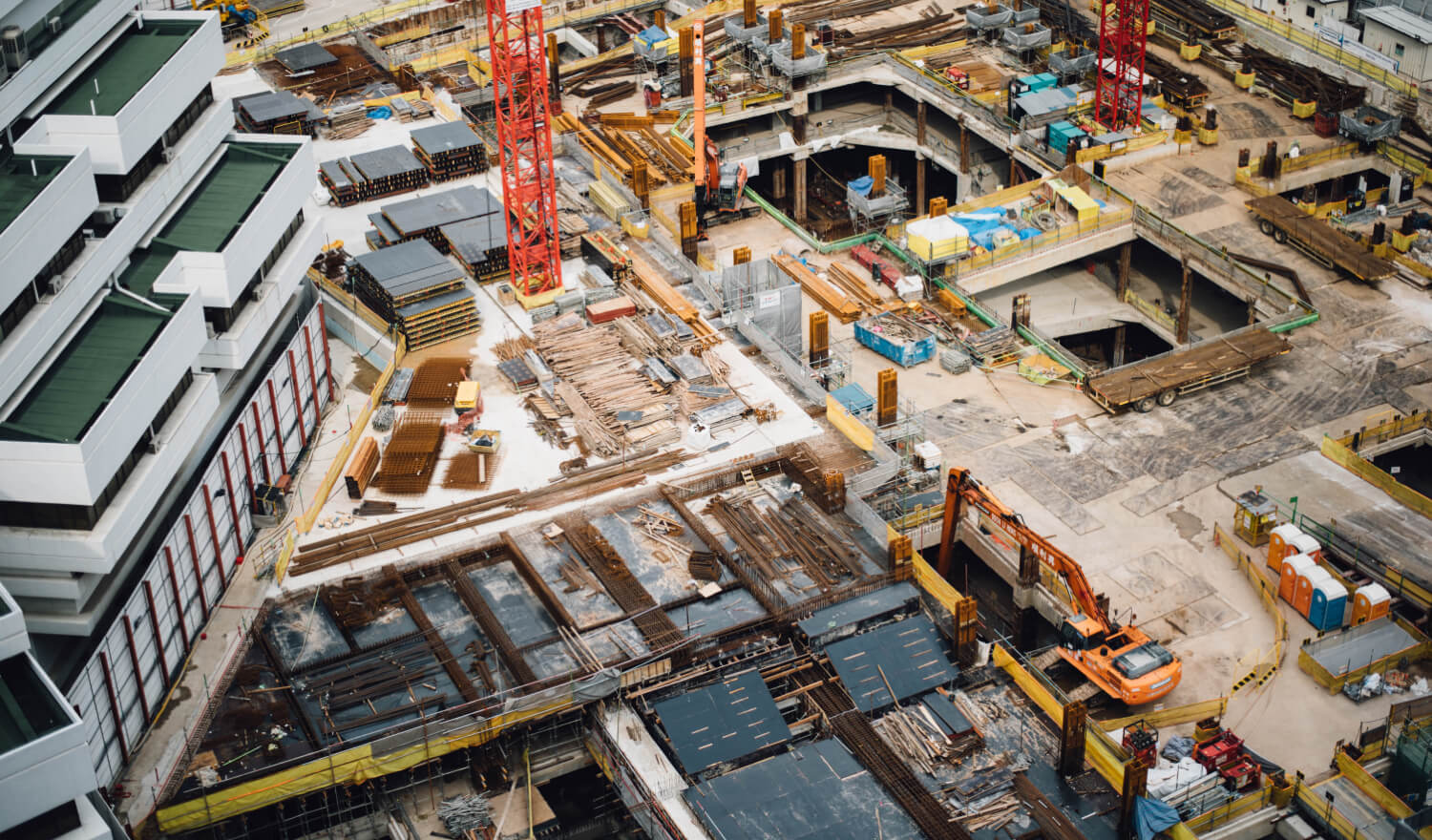
The building and civil engineering sectors account for 70% of the waste generated by volume in France each year, or 228 million tonnes. Most of this waste is non-hazardous and therefore easy to recover.
Context and key facts
A heavy environmental toll
The building and civil engineering sectors account for 70% of the waste generated by volume in France each year, or 228 million tonnes. Most of this waste is non-hazardous and therefore easy to recover.
Looking at the building sector alone, excluding civil engineering, it is at once:
- A significant producer of waste: 46 million tonnes a year in France
- A major contributor to greenhouse gas (GHG) emissions: around a quarter of French emissions and a third of EU emissions (construction + operation)
- A major consumer of raw materials (energy, water, minerals, and so on)
Economic and legislative pressures are pushing the sector to change its practices fast
Making the building sector more circular is now not only necessary from an environmental standpoint, but also from an economic and regulatory one.
First, tenders - public ones in particular - are imposing more and more environmental criteria, notably on waste management, which companies must be able to meet if they are to keep winning contracts.
Construction players have also been facing sharp price rises and shortages of certain raw materials (steel, timber, polystyrene, PVC and more) for several months.
The health context has significantly reinforced the need to commit to a circular economy for construction. Remote working is accelerating thinking on how buildings are used and how they can be repurposed, while supply issues raise the question of the resilience of local areas, and of cities in particular.
National and European legislation is also becoming increasingly demanding when it comes to the carbon footprint of buildings and the traceability and recovery of construction waste. Looking only at the implications of the AGEC law in France, construction players face numerous legislative changes, including:
- Creation of an EPR scheme (Extended Producer Responsibility) for construction, postponed to 01/01/2023 - initially scheduled from 01/01/2022;
- Obligation for the client (MOA) to carry out a Products-Materials-Waste assessment (DPMD);
- Obligation for collection facilities to issue a deposit slip free of charge to the works contractor from 01/07/2021;
- Obligation for public procurement to source a share of goods from reuse or recycling (see decree of 21/11/2021);
- Obligation to sort 6 waste streams at source on sites (wood, mineral fractions, metal, glass, plastic, plasterboard);
What specific role for local authorities?
The new ordinance on waste prevention and management (no. 2020-920, 29/07/2020) states that it is up to local authorities to ensure that certain construction and demolition waste streams (mineral fractions, plasterboard and wood) are properly sorted. The ordinance also allows local authorities that promote waste prevention and step up separate collection to benefit from an incentive-based charging system, the contractual terms of which are to be set with inter-municipal bodies or joint associations and their member authorities. Note that since the adoption of the AGEC law, the competent authorities can require "reuse zones" for social economy players to be set up within household waste recycling centres.
The circular transition of the building sector: what does it mean in practice?
Because the circular economy covers many concepts and possible applications, various pieces of work have been carried out to define precisely how the approach could be applied to the building sector. Of particular note are the 6 levers for rolling out the circular economy in construction studied by the Fondation Bâtiment-Energie (created by ADEME and the CSTB) between 2018 and 2020:
- Developing reuse practices (to be distinguished from recovery for reuse, which involves passing through waste status);
- Sourcing resources locally and reducing transport distances;
- Extending the lifespan of materials;
- Reversibility and change of use of buildings (functional economy);
- Design for disassembly (eco-design of buildings);
- Capturing data throughout the life cycle of materials.
Emerging solutions and tools
Numerous solutions are emerging to meet the challenges of embedding the circular economy in construction: a denser local network of collection points, changing regulatory obligations, innovative technology tools, cross-industry collaboration and more.
Here are a few examples of tools available to construction players wanting to get started:
MaTerrio.construction resource centre
By whom: FNTP & UNICEM. For whom: local authorities, companies & project managers. What: tools (including geolocation) and publications to shed light on the recovery of construction waste in France. More at: materrio.construction
Le Booster du Réemploi
By whom: A4MT and several partners. For whom: all construction players. What: an alliance launched in 2021 to grow and make demand for reused materials predictable (via a digital platform), help construction players specify reuse easily, and support the growth of companies specialising in reuse. More at: boosterdureemploi.immo
The circular economy training programme from CCCA-BTP and Agyre
By whom: CCCA-BTP, Agyre & WinLab' Innovation Lab. For whom: clients, project managers, companies & manufacturers. What: a training programme launched in 2021 for all construction players, introducing them to the various circular economy practices. More at: winlab-cccabtp.com
3 examples of digital platforms for reusing construction materials and equipment
Cycle Up: a marketplace for the reuse of building and property materials, aimed at professionals
Backacia: a marketplace for the reuse of construction materials and equipment, aimed at professionals
Re.Source: a marketplace for the reuse of building materials where sellers are professionals and buyers are individuals or tradespeople
Free, useful resources to go further
To deepen your knowledge of the subject, we invite you to watch the replay of the webinar held by the Grand Paris metropolitan authority and Circul'R on 29 September on the theme of material reuse in construction. You will also have the chance to discover the Cycle Up solution mentioned above through a digital site visit.
Other useful resources:
- Intégrer l'économie circulaire dans le BTP, April 2021, INEC & Enckell Avocats
- Economie circulaire dans le bâtiment, Synthèse des recherches, Fondation Bâtiment-Energie (FBE)
- Le bâtiment à l'heure de l'économie circulaire, Bâtimétiers no. 43-2016, Fédération Française du Bâtiment (FFB)
FAQ
What you need to know about us.
Qu'est-ce que Circul'R ?
Circul'R est un cabinet de conseil spécialisé en économie circulaire. Depuis 2016, il accompagne plus de 150 grandes entreprises et acteurs publics à travers des missions de conseil, des coalitions sectorielles, des programmes de formation et le Club Circul'R.
What types of organizations do you work with?
Contrairement à un cabinet RSE généraliste, Circul'R est spécialisé exclusivement en économie circulaire depuis 2016. Cette expertise transverse - filières, réglementations (AGEC, REP, ESPR), business models - lui permet de transformer la circularité en avantage compétitif mesurable : réduction d'impact, sécurisation des ressources, conformité et nouveaux relais de croissance.
What is the process for a consulting project with Circul'R?
Circul'R conseille les grandes entreprises privées - dont de nombreux groupes du CAC 40 et du SBF 120 - sur leurs décisions stratégiques, tous secteurs confondus. Le cabinet accompagne également les acteurs qui déploient les politiques publiques d'économie circulaire : éco-organismes, agences, bailleurs de fonds et collectivités.
Do you operate only in France or internationally as well?
Circul'R propose quatre offres complémentaires : des missions de conseil sur mesure pour structurer votre stratégie circulaire, des coalitions sectorielles pour résoudre des problématiques communes entre entreprises, des formations pour monter en compétence sur l'économie circulaire, et le Club Circul'R, le réseau des entreprises engagées dans la transition circulaire.
How can the circular economy be practically integrated into an existing business strategy?
Circul'R accompagne ses clients sur l'ensemble du cadre réglementaire français et européen de l'économie circulaire : loi AGEC, filières REP, CSRD, ainsi que les textes européens récents (PPWR, ESPR, CRMA). Le cabinet traduit ces obligations en feuilles de route opérationnelles, pour transformer une contrainte de conformité en avantage stratégique.
What is a sector-based coalition and how can I participate?
Une mission démarre par un diagnostic de vos enjeux circulaires (approvisionnement, éco-conception, business model, réglementation, etc.). Circul'R construit ensuite une feuille de route chiffrée et priorisée, avant d'accompagner le déploiement opérationnel des actions retenues jusqu'à la mesure d'impact et l'ajustement continu de la trajectoire.
How do you measure the results of your projects?
Basé à Paris, Circul'R intervient principalement en France et en Europe. À l'international, il accompagne des projets de coopération : partage de l'expertise française sur la REP, appui aux bailleurs de fonds sur leurs programmes de transition circulaire dans les pays émergents, via un réseau de partenaires opérationnels et d'experts sectoriels.
What is the average duration of a project?
Contactez l'équipe via le site : Circul'R analyse vos enjeux puis propose le dispositif adapté (mission de conseil, rejoindre une coalition, suivre une formation ou adhérer au Club) pour accélérer votre transition vers l'économie circulaire.